
Local SEO: How to Get Your Business Found in "Near Me" Searches
When people search "near me", Google shows a map with three businesses. Here is how local SEO helps you become one of them.

"Near me" searches are some of the most valuable searches a local business can appear in. The person searching usually wants something soon: a doctor today, a salon this weekend, a caterer for next month. Google answers with a map showing three businesses, then everyone else below.
Getting into those three spots is what local SEO is all about.
How Google picks local results
Google says local results are mainly based on three things:
- Relevance: how well your profile and website match what was searched.
- Distance: how far your business is from the searcher or the area in the search.
- Prominence: how well known and trusted your business is, judged by reviews, links, mentions and overall web presence.
You can't move your shop closer to every customer, but you can do a great deal about relevance and prominence.
Step 1: Make your Google Business Profile complete
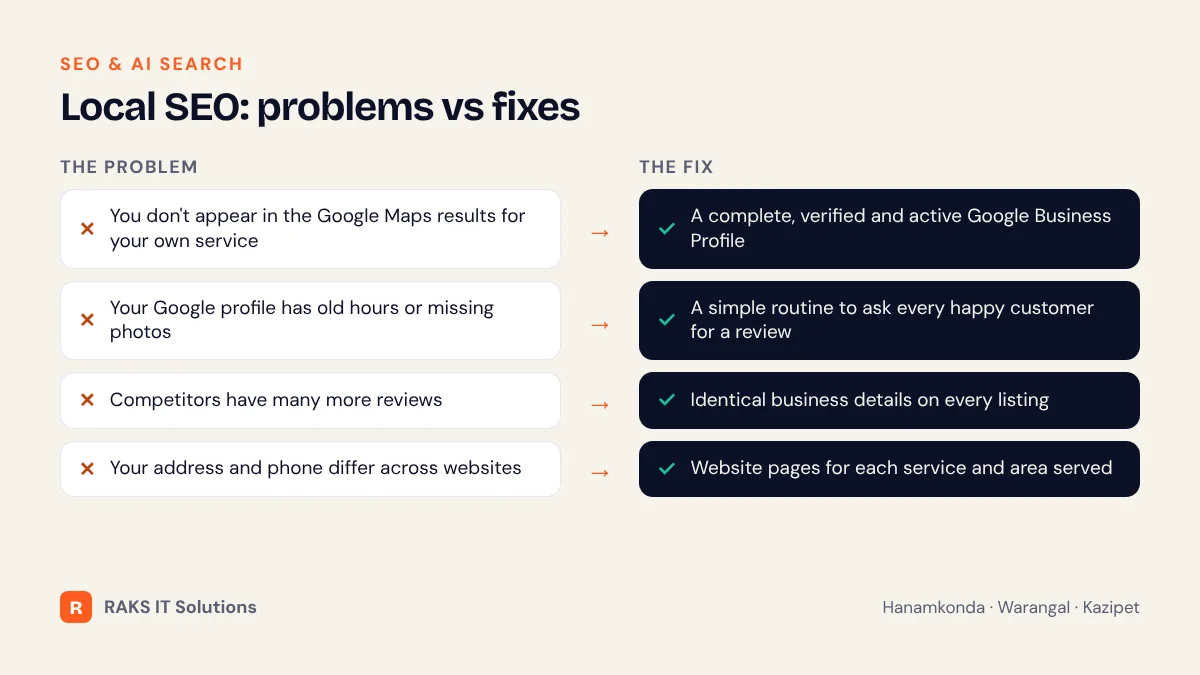
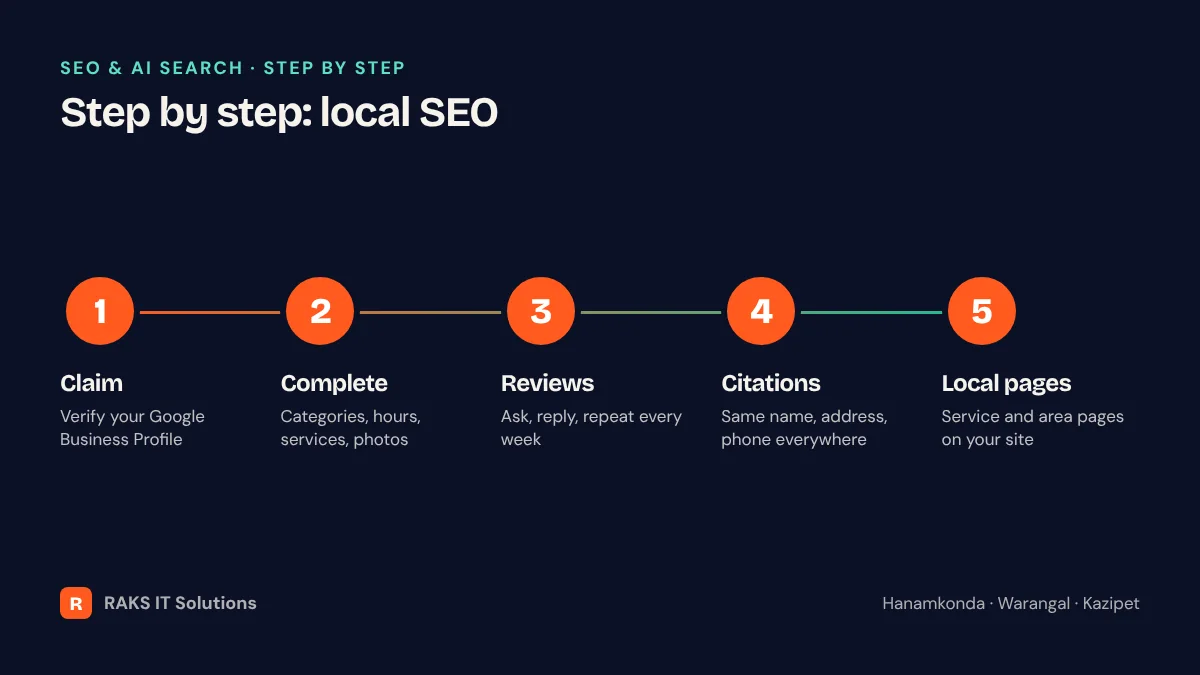
Your Google Business Profile is the listing that appears on Maps and in local results. Most businesses claim it and then forget it. Treat it like a second website:
- Choose the most accurate primary category and relevant secondary ones.
- Add every service, with short descriptions.
- Keep hours correct, including holidays.
- Upload real photos: storefront, team, work, products. Add new ones regularly.
- Write a clear business description mentioning what you do and where.
- Use posts for offers, events and updates.
- Answer the questions section before customers ask.
Step 2: Build a steady flow of genuine reviews
Reviews influence both rankings and decisions. Make asking for them a habit, not an occasional campaign:
- Ask at the moment of satisfaction, when the job is done or the customer says thanks.
- Send a direct review link by WhatsApp so it takes one tap.
- Reply to every review, good or bad, politely and personally.
- Never buy fake reviews. They violate Google's policies and customers can spot them.
Step 3: Keep your details identical everywhere
Your business name, address and phone number (often called NAP) should match exactly on your website, Google profile, Facebook, Justdial, IndiaMART, Sulekha and any other listing. Mismatched details confuse search engines and customers.
Step 4: Give your website a local backbone
Your website supports your map ranking and also ranks on its own in regular results:
- A page for each main service.
- Clear mention of the city and the areas you serve.
- Your address, map and directions on the contact page.
- LocalBusiness structured data with your address, hours and coordinates.
- Pages for the nearby areas you genuinely serve, with useful local information rather than copied text.
Step 5: Earn local mentions
Local newspaper features, association memberships, event sponsorships, college partnerships and supplier listings all build prominence. One relevant local mention is often worth more than many random directory links.
Measuring local SEO
In your Google Business Profile performance section, track calls, direction requests, website clicks and searches over time. Pair that with Google Search Console data for your local pages and the enquiries arriving through your website.
A local example
Customers in the Warangal Tri-City search in different ways: "near Hanamkonda bus stand", "in Kazipet", "Warangal". A profile and website that reflect the real areas you serve, with honest local details, help Google connect you to those searches. See our local SEO services in Hanamkonda and Kazipet for how we approach each area.
The bottom line
Local SEO is not a one-time setup. It is a routine: keep the profile fresh, collect reviews every week, keep details consistent and strengthen your website. Businesses that do this consistently tend to own the map for their services.


